From Industry 1.0
To Industry 4.0

History of Women's Economic Empowerment


 Explore
Explore
Explore
The analysis and visualization of our data consisted of two parts. Firstly, we calculated and analyzed various data on women's work and wages from the Knaresborough workhouse daybook. Secondly, we collected data on women's work and employment in the UK in the current situation, in the context of the fourth industrial revolution. By linking and analysing historical and contemporary sources, we hope to present a valid discussion on women's economic empowerment and escape from poverty.
Following an examination of female inmates' activities in the Knaresborough workhouse, we notice that the first Cotton Mill in the area - Knaresborough Cotton Mill's establishment on 22 September 1791, created a novel avenue of employment for women. Since its inception, there has been an increase in the participation of female inmates in the Cotton Mill's workforce.
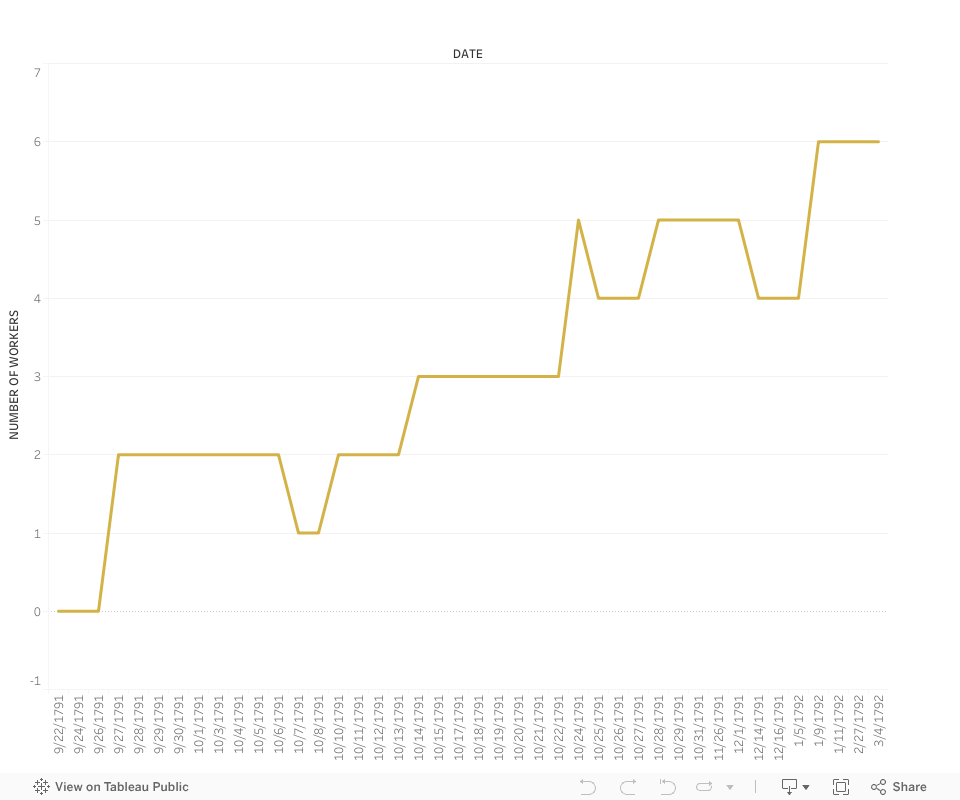
The development of the cotton industry in the region has brought a notable shift in the distribution of labor among female inmates at the Knaresborough workhouse. There has been a substantial rise in the proportion of women engaging in skilled textile work, such as spinning, winding, and cotton dressing, from 60% to 71%. In contrast, unpaid home-based jobs, including house chores and child-tending, have witnessed a decline in participation.
Wages can be calculated from the workhouse incomes brought by the inmates recorded in the daybook accounts. Female inmates working in the cotton mill (2.5 shilling/week) receive relatively high wages compared to those doing traditional worsted spinning (1 shilling/week) and line spinning (0.58 shilling/week) in the house.
The first Industrial Revolution saw significant advancements in power technology and the flourishing of the textile industry. From the example of the Knaresborough workhouse, we can see that the erection of the cotton mill in the region brought new job opportunities and relatively higher wages for female workers, which provided a potential means for women in poor economic conditions to improve their lives and escape extreme poverty.
While technological and productivity advancements have brought women new work opportunities and economic empowerment since the 18th century, the persistence of the gender pay gap continues to pose challenges for women seeking adequate economic income.
During the Industrial Revolution era, the gender pay gap was so significant (ranging from 1/3 to 2/3 female to male) that it could not be justified by differences in productivity.
The digital revolution has created a broader range of career options for women, allowing them to fully utilize their unique skills. As a result, female employment rates have increased, and the gender pay gap has decreased. The UK Labor Force Survey from 1971 to 2022 shows a positive trend, with the female employment rate increasing from 52.8% to 72.3%. In 2022, the gender pay gap in the UK stands at 14.9%, significantly reduced from 27.5% in 1997.
We are presently experiencing the 4th industrial revolution, marked by the ongoing evolution of various digital technologies, such as mobile devices, artificial intelligence, and the Internet of Things. What are opportunities brought by the emergence of these technologies? Let's find out!
Fueled by the growing demand for online services and the development of digital platforms, The platform economy and the gig economy are rapidly expanding (OECD, 2018). This trend has notably reduced physical barriers and facilitated women's participation in the labor market. Online platforms enable women to match their skills to the labor market and expand their employment choices (OECD, 2018). Additionally, digital platforms offer women the flexibility to choose their work location, schedule, and mode of work, enabling them to achieve a better work-life balance (B2E CONSULTING, 2023).
Women have made significant inroads into the labor markets of the platform and odd-job economies (Hunt et al.,2019). For instance, 67% of Airbnb homeowners are women (OECD, 2017); 86% of sellers on the US digital home improvement platform Etsy are women (BLS, 2016); and women make up 57% of workers on Amazon MTurk, a crowdsourcing marketplace (Moss, 2020).
According to the 2022 UK Employment Distribution Statistics for women, the top three occupations for women are those that involve significant human interaction. These occupations are Human Health & Social Work, Education, and Wholesale & Retail.
These occupations are less vulnerable to the impact of the 4th industrial revolution, and cannot be easily replaced by automation or engineering. A high proportion of female workers in these fields in these fields making this a significant opportunity for them to thrive in their careers and less likely to face job losses.